Science
MS Swaminathan obituary
Agricultural scientist who helped India become self-sufficient in food grain production
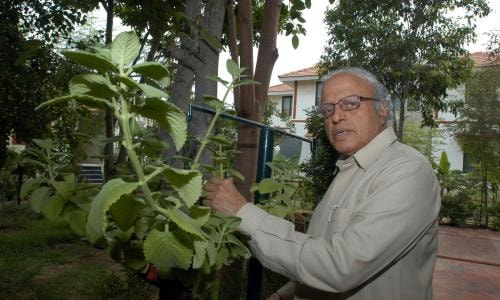
In the 1950s Monkombu Sambasivan Swaminathan, who has died aged 98, set about leading India’s journey from an being agricultural “basket case” to a “bread basket”. The resulting transformation became known as its green revolution. When he started, rises in India’s food grain production were driven primarily by increases in cultivated area. But by the early 60s, no new areas were available for cultivation and the population was still growing. Frequent droughts triggered bouts of food price inflation. In 1965, the prime minister, Lal Bahadur Shastri, urged Indians to skip a meal every week. Wheat imports from the US under the PL-480 aid scheme provided the only solace. It was imperative that India’s food grain production should rise decisively, and quickly. But yields in India’s food grains were low. The country’s soils were deficient in organic matter and critical nutrients. Traditional wheat and rice varieties were tall-statured, leading to crop losses through lodging (bending or breaking of stems); were of long duration, ruling out an additional crop in the same year; were photoperiod-sensitive, which affected flowering when day lengths shortened; and were susceptible to pests and diseases. In close association with the American agronomist Norman Borlaug, Swaminathan demonstrated that these limiting and reducing yield barriers could be genetically transcended. They identified dwarf traits in the Japanese wheat variety Norin 10 and the Chinese rice variety Dee-geo-woo-gen. These varieties were also photoperiod-insensitive and responsive to the application of fertilisers. They were crossed with Indian varieties to produce new varieties suited to Indian conditions. Swaminathan first met Borlaug in 1953 as a postdoctoral research associate in genetics at the University of Wisconsin-Madison. At their first meeting, they struck up a friendship over a cup of coffee that was to grow into a remarkable association that continued until Borlaug’s death in 2009, when Swaminathan reminisced: “He was like my elder brother.” Swaminathan led the development of several wheat and rice varieties – the “miracle grains” – that were to help India take great leaps forward in food grain production. India doubled its wheat production from 10m tons in 1963-64 to 20m tons in 1969-70. The remarkable increase was why the green revolution deserved to be known as a revolution, Swaminathan would argue, as opposed to the traditional pathways of evolution. This revolution helped India become self-sufficient in food grain production – though successive governments faltered in distributing these food grains to the hungry. As yields increased, India raised its overall food grain production from 89m tons in 1963-64 to 331m tons in 2022-23, even as the cultivated area remained largely unchanged: 117m hectares in 1963-64 and 130m hectares in 2021-22. Consequently, the green revolution was also “forest-saving” – an unintended outcome then, but acknowledged as valuable in today’s times of global warming. Swaminathan was born in Kumbakonam, a village in the south Indian state of Tamil Nadu. His father, Monkombu Kottaram Sambasivan, a renowned surgeon and a follower of Mahatma Gandhi, died when Swaminathan was 11 years old. In 1940, after Swaminathan had left the Catholic Little Flower high school in Kumbakonam, his mother, Parvati Thangammal, sent him under the care of his father’s brothers to Travancore, a part of today’s state of Kerala, for further education. He graduated with a BSc in zoology from University College, Thiruvananthapuram, in 1944. In 1942, Gandhi had called for a “Quit India” movement, which inspired many among India’s enlightened youth to dream of a “free India”. The Bengal famine – a tragic legacy of colonial plunder – struck in 1943. An estimated three million Indians died in it, presenting Swaminathan with two choices: to join a course in medicine or a course in agricultural science. Fired with a vision of a famine-free India, in 1944 Swaminathan joined the Agricultural College, Coimbatore (now Tamil Nadu Agricultural University), for another BSc, and the Indian Agricultural Research Institute (IARI), New Delhi, as a graduate student in 1947. From there in 1949 he went to Wageningen agricultural college in the Netherlands as a fellow. In 1952, he obtained his PhD in genetics from Cambridge University, and the following year went to the University of Wisconsin-Madison’s laboratory of genetics, where he encountered Borlaug. He returned to India in 1954, and joined the IARI, where he would serve for 18 years – rising from an assistant cytogeneticist to the institute’s director. It was where Swaminathan led the breeding of high-yielding rice and wheat varieties from. He was appointed the director-general of the Indian Council of Agricultural Research in 1972 and principal secretary of agriculture to the government of India in 1979. A new phase in Swaminathan’s career began in 1982, when he was appointed director-general of the International Rice Research Institute (IRRI) in the Philippines. At IRRI, Swaminathan was involved in strengthening its International Rice Germplasm Centre, a global gene bank that presently holds about 132,000 accessions from about 150,000 types of rice seedlings. In 1986, he was instrumental in ensuring that the war-torn Cambodia (then Kampuchea) was supplied with copies of traditional rice seeds from the gene bank that had been lost in the long years of conflict. In 1987 Swaminathan was awarded the first World Food prize. He used his prize money to establish the MS Swaminathan Research Foundation (MSSRF) in Chennai in 1988, and served as its chair until 2012. MSSRF undertakes important fundamental research on coastal systems, biodiversity, biotechnology, ecotechnology, nutrition and climate change. Between 1984 and 1990, Swaminathan served as the president of the International Union for Conservation of Nature. In 1983, he was appointed chair of the advisory panel on food security under the World Commission on Environment and Development (the Brundtland Commission). In both positions, Swaminathan’s interventions were significant in evolving a global consensus around the objectives of “sustainable development” and “sustainable livelihoods”. In 2015, Kenneth M Quinn, president of the World Food Prize Foundation, wrote that Swaminathan belonged to “the rarefied pantheon of the world’s most outstanding agricultural leaders and humanitarian heroes”. The government of India bestowed its highest civilian honours on him: Padma Shri (1967), Padma Bhushan (1972) and Padma Vibhushan (1989). In 1955, Swaminathan married Mina Bhoothalingam, an educationist. She died in 2022. They are survived by three daughters, Soumya, Madhura and Nitya. • Monkombu Sambasivan Swaminathan, agricultural scientist, born 7 August 1925; died 28 September 2023
Read on theguardian.comKeep reading